
The audit date is on the calendar, the auditor is booked, and the difference between a clean pass and a major non-compliance usually comes down to one thing: paperwork, not farming.
That's the hard part about a global gap audit. You can run a textbook operation and still get flagged because a spray log is missing an applicator's name, a water test expired, or a lot can't be traced forward to the customer. Major findings can mean certificate suspension — and with it, the retail contracts behind it.
This checklist is for the operation with an audit date in sight: what auditors check, an 8-week countdown, the documentation to assemble, and how to run a mock audit before the real one. For background on what GLOBAL G.A.P. is and how certification works, start with our GLOBAL GAP certification overview, then come back here to build your audit pack.
What Auditors Actually Check
GLOBAL G.A.P. certification runs through an approved, independent certification body (CB). The audit has two halves:
- Document review. The auditor works through your records — spray logs, training files, traceability documentation, water tests — checking that they're complete, current, and legible.
- On-site inspection. The auditor walks the operation, inspects equipment and storage, observes work practices, and interviews workers to verify that what your records say is what actually happens.
Some CBs split these into a desk review and a site visit; others run both in one day. Ask when you book.
What's being checked is the Integrated Farm Assurance (IFA) standard, GLOBAL G.A.P.'s flagship for fruit and vegetables. IFA is modular: foundational requirements every producer must meet, sector-level requirements for crops, and product-specific requirements for fruit and vegetables. The current version, IFA v6, organizes requirements as principles and criteria (P&Cs) — older versions called them control points and compliance criteria (CPCC), and you'll still hear both terms.
P&Cs are graded Major Must, Minor Must, and Recommendation. Certification requires 100% of Major Musts and at least 95% of Minor Musts. Every non-compliance needs a corrective action submitted to your CB within their window and verified as closed before the certificate is issued. A successful audit earns a certificate valid for one year, renewed by an audit booked inside the current certificate's validity period.
Auditors verify records against practice. If your documentation and your fields disagree, the documentation loses.
The 8-Week Audit Countdown
The certification documents — general regulations, IFA P&Cs, and the audit checklist — are free to download from GLOBAL G.A.P. in multiple languages. The checklist doubles as a self-assessment tool, and it drives this timeline.
| Weeks Out | Focus | What to Do |
|---|---|---|
| 8–6 | Register and baseline | Confirm registration and your certification option (individual, multisite, or producer group) with your CB. Download the IFA v6 P&Cs and checklist — buyers determine whether you need the GFS or Smart edition. |
| 6–4 | Gap analysis | Walk your operation against the checklist section by section. Fix structural gaps — traceability flow, storage, signage — now, because physical fixes take longer than paperwork. |
| 4–2 | Assemble records | Pull records by category (tables below). Chase missing signatures, expired tests, and illegible entries. Train your crew on the interview questions auditors ask. |
| 2–0 | Mock audit and corrections | Run the mock audit (below). Close every finding. Assemble the final document pack and confirm logistics with your CB. |
Coming in under eight weeks? Compress the middle phases, but don't skip the mock audit.
The Documentation Checklist by Category
Exact requirements depend on your scope, edition, and country — your CB confirms the applicable checklist. These seven categories cover what fruit and vegetable growers get asked for most.

| Category | What the Auditor Asks For | What a Passing Record Looks Like | Common Failure Mode |
|---|---|---|---|
| Traceability & lot records (seed to sale) | One-step-back/one-step-forward traceability: where every lot came from and where it went. Seed lots, harvest, packing, and shipping records. | Every lot carries a unique ID linked back to the block and harvest date, and forward to the immediate customer — traceable end to end in minutes. | Orphaned lots that can't be tied to a block or buyer, or one-directional traceability. |
| Spray / agrochemical records | Application records for every plant protection product: product and registration number, rate, dilution, date and time, block, applicator identity, and PHI and REI compliance confirmation. | Every application logged when it happened, with applicator, PHI, and REI captured every time. | Missing or illegible entries, missing applicator identity, PHI/REI compliance not documented. |
| Application records & biologicals | Records for fertilizers, biostimulants, and biological inputs, tied to a documented nutrient program or IPM plan. | Purchase records and application logs reconcile, and applications follow a documented plan. | Product on the shelf that never appears in the application log. |
| Worker safety & training (and GRASP) | Training records per worker, safety signage in the right languages, first aid and hygiene facilities, incident procedures. If assessed to the GRASP add-on: employment terms, wage and time records, worker representation, and protections for child and young workers. | Signed, dated training records for every current worker, refreshed annually, plus safety materials the crew can describe when interviewed. | Training records for last season's crew only; GRASP gaps in wage and time records. |
| Irrigation water test records | A water source inventory and current test results for each source, at the frequency your CB requires. | A dated test for every active source within its validity window, with corrective action documented for any failed result. | Expired tests, untested seasonal sources, or a failed result with no follow-up. |
| Mock recall / traceability documentation | A documented traceability procedure, a crisis or recall management plan, and evidence of a mock recall exercise with results and timings. | A mock recall completed in the last 12 months, with the lot traced both directions within your target time. | A written plan that's never been exercised — auditors ask for the record, not the plan. |
| Site & equipment records | Cleaning and maintenance logs, calibration records, agrochemical storage checks, empty container disposal records. | Regular, dated entries — cleaning, calibration, and maintenance written down when they happen. | Gaps between service dates, or calibration records that stop mid-season. |
Traceability is the category where digital records earn their keep fastest. For what one-step-back/one-step-forward means in practice, see our traceability resource.
The Most Common Non-Compliances
Ranked by how often they show up as findings in GAP audits generally:
- Incomplete traceability. A lot that can't be traced one step back or forward is a Major Must problem — usually a receiving or shipping record that never got written down.
- Missing or illegible spray records. The application happened, but the record didn't — or only the applicator can read it.
- PHI/REI documentation gaps. The intervals were respected in the field, but nothing proves it. Auditors score what you can show, not what you did.
- Outdated training records. New hires without documented training, or annual refreshers that lapsed at season change.
- Unverified or expired water tests. A test past its validity window, or a source never tested.
- Mock recall never performed. The plan exists; the exercise record doesn't.
- Storage and container hygiene gaps. Cleaning logs with stretches of missing dates.
None of these are hard to fix eight weeks out. All of them are painful to explain on audit day.
How to Run a Mock Audit
A dress rehearsal for both halves of the real audit — one day, your own records, no excuses:
- Morning: document review. Work through the IFA v6 checklist against your actual records, as an auditor would. Mark every point you can't evidence in five minutes.
- Walk the site. Inspect chemical storage, wash stations, equipment, and signage. Note anything a stranger would question.
- Interview your crew. Ask what auditors ask: what does this sign mean, where do you report an injury, what did you train on this year. A shrug is a finding.
- Run the mock recall. Trace a shipped lot back to the block and forward to the customer against the clock. More than four hours means your system isn't ready.
- Score and close. Assign every gap an owner and a deadline, then verify the fixes with evidence, not intentions.
For what a completed traceability exercise should produce, see the mock recall report walkthrough.
Since spray documentation is the section GAP audits review most closely, our spray record keeping guide covers what belongs in every application record.
Where Digital Records Pay Off
Audit prep exposes what paper systems hide. Spreadsheets sprawl into version chaos — three copies of the spray log, none current. Paper logbooks go illegible exactly when they matter most. Lots get created in one system and shipped in another, and the connection lives in someone's head. Two weeks before the audit, someone spends three days cross-referencing photocopies and still misses the blank field the auditor finds in ten minutes.
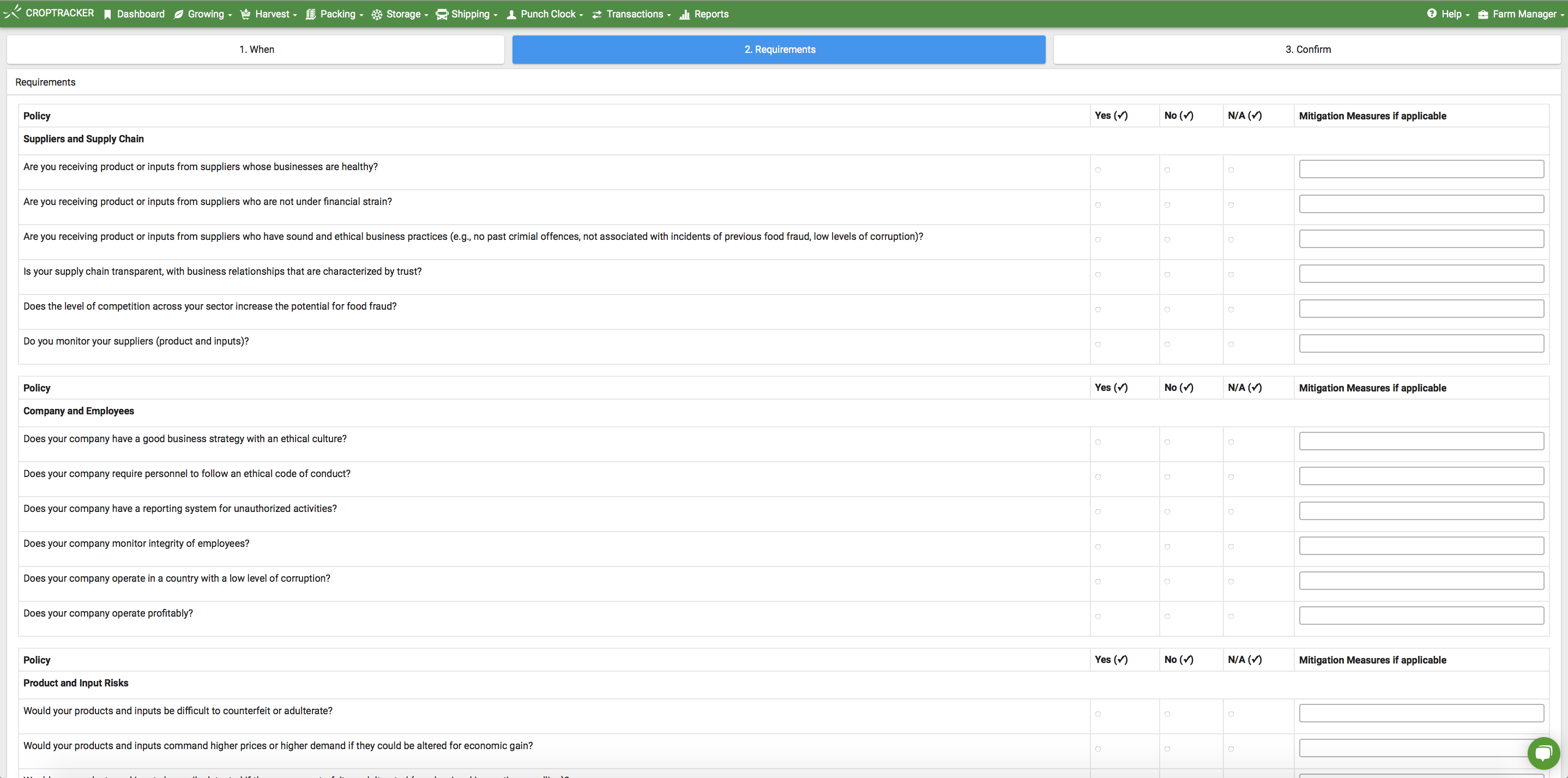
This is where the records you already keep start working for you. Croptracker's GAP Reports and Audits module generates audit-ready reports from the records your operation logs day to day — spray, harvest, traceability, and labor — so audit prep becomes a review, not a reconstruction.
The heavy-lifting categories map directly:
- Spray records. Croptracker's Spray record keeping captures product, rate, applicator, block, and PHI/REI at application time, so entries are complete and legible by default.
- Worker and GRASP evidence. Farm Labor Tracking with Punch Clock keeps time, wage, and training documentation consistent — the record base GRASP assessments draw on.
- Traceability and recall reporting. Lot-level records from harvest through shipping feed one-step-back/one-step-forward reports, so the mock recall takes minutes.
FAQ
How long is a GLOBAL G.A.P. certificate valid? One year. Compliance is audited annually by an approved certification body, and the renewal audit must fall within the validity period of your current certificate to keep certification status continuous. Contact your CB to schedule the renewal audit before expiry.
What happens if you fail a GLOBAL G.A.P. audit? You don't automatically fail — you receive findings. To certify, you must meet 100% of Major Musts and at least 95% of Minor Musts. For any non-compliance, you submit corrective actions to your CB within their specified period; the CB verifies the corrections before issuing a certificate.
What is the difference between IFA and GRASP? IFA is the core certification standard covering food safety, environment, workers' health and safety, production processes, and traceability. GRASP is an optional add-on assessed alongside the IFA audit by the same CB, covering workers' voice, human and labor rights, and protection of child and young workers. It results in a letter of conformance, not a certificate.
How much does a GLOBAL G.A.P. audit cost? Costs vary by farm size, location, and certification option, and include three elements: your preparation costs, CB service fees for audit time and travel, and GLOBAL G.A.P. registration and license fees based on production area. CBs quote service fees individually — get quotes from approved CBs in your country and check the GLOBAL G.A.P. fee table.
Putting It Together
An audit pass isn't a heroic sprint the week before. It's what happens when records get written down correctly the first time — which is what the checklist above is built to prove. Start at week eight, run the mock audit honestly, and walk into audit day with a pack you'd show anyone.
For background on the certification itself — IFA, the HPSS for North American producers, and how GLOBAL G.A.P. fits into the GFSI family — our GLOBAL GAP certification overview covers it from the ground up.
References
- GLOBAL G.A.P., "Integrated Farm Assurance for fruit and vegetables" — standard structure, P&Cs grading, audit process, certificate validity, IFA v6 editions. https://GLOBAL Gap.org/what-we-offer/solutions/ifa-fruit-and-vegetables/
- GLOBAL G.A.P., "GLOBAL G.A.P. Risk Assessment on Social Practice (GRASP)" — GRASP v2 scope, assessment process, pass thresholds. https://GLOBAL Gap.org/what-we-offer/solutions/grasp/
- GLOBAL G.A.P., corporate homepage — "GLOBAL G.A.P. in numbers" (130+ countries, 195,000+ producers, 190+ CBs). https://GLOBAL Gap.org/